
Data centers use load banks to simulate real-world loads during pre-deployment testing. Standard practice. But one fact tends to go unnoticed: traditional resistive load banks convert 100% of the test energy into heat. They burn through your electricity — literally.
At smaller scales and short durations, this barely registers. At hundreds of kilowatts or megawatts, with frequent or extended test runs, the economics shift. A single 4-hour full-load test on a 500 kW UPS consumes about 2,000 kWh. At German industrial rates (roughly €0.25–0.35/kWh), that is €500–700 per test — gone as heat.
This article looks at a different approach: regenerative load banks. Their operating logic is not to consume energy, but to return it to the grid.
What a Resistive Load Bank Does
A resistive load bank is straightforward. It contains banks of high-power resistor elements. Current from the device under test flows through them, electrical energy becomes heat, and fans exhaust it into the environment.
Energy efficiency: 0%. All input power becomes thermal waste.
The advantages are equally clear: simple design, fast deployment, no grid connection needed, relatively low upfront cost. For infrequent, short-duration testing, this is a mature and reliable solution.
Key insight: Resistive load banks do exactly what they are designed to do. The question is not whether they work — it is whether the cost of that heat output has become worth optimising in your specific testing scenario.
When Testing Scales Up, Hidden Costs Surface
Beyond the electricity bill, three factors compound at higher power levels:
Cooling capacity
High-power testing generates substantial heat. Not every facility can handle the necessary heat rejection — some sites simply lack the exhaust or chiller infrastructure.
Noise
High-speed cooling fans running at full load are a genuine problem near offices, residential areas, or noise-sensitive environments.
Carbon footprint
For projects with ESG compliance requirements, purely consumptive energy use during testing needs to be explained — and increasingly, reduced.
Regenerative Load Banks: A Different Approach
A regenerative load bank takes a fundamentally different path. Instead of burning energy through resistors, it uses power electronics to convert test energy into grid-compliant AC and feed it back to the mains.
In a typical test setup, energy flows like this:
Grid → Transformer → UPS (device under test) → Regenerative Load Bank → Feedback point (between Transformer and UPS) → Transformer → Grid
Energy does not vanish at the end of the chain. It completes a closed loop.
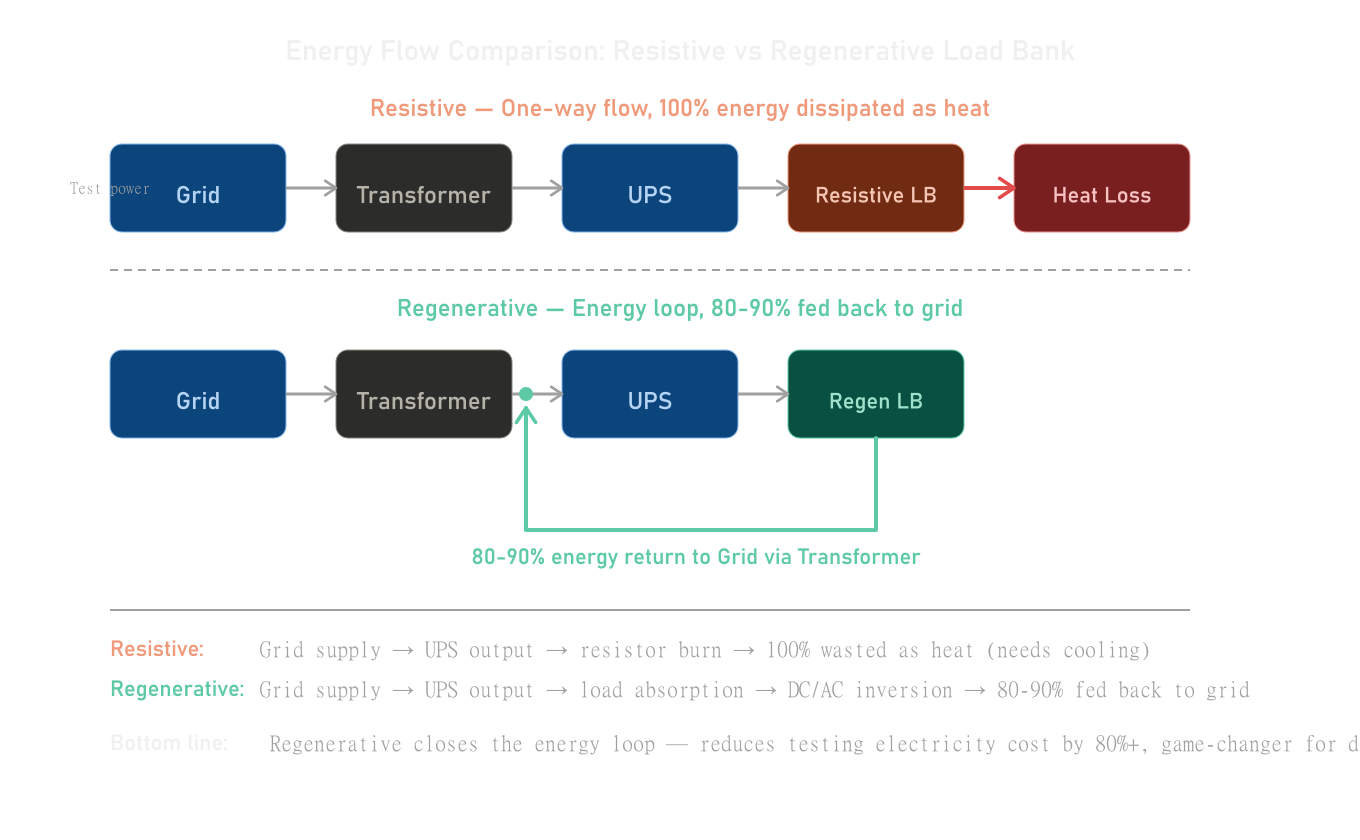
Top: Resistive — one-way flow ending in heat. Bottom: Regenerative — closed energy loop returning to grid.
The internal topology includes four power stages:
- Rectifier — converts AC to DC
- DC bus — capacitors stabilise voltage and buffer energy
- Inverter — converts DC back to AC, with real-time phase-locked loop synchronisation to grid frequency and phase
- Output filter — suppresses harmonics to meet grid interconnection standards
Functionally, a regenerative load bank serves dual roles: a controllable load for the device under test, and a grid-tied inverter. Typical regeneration efficiency: 80–90%. Only 10–20% is lost in semiconductor switching and conduction.
Comparing the Two Approaches
| Dimension | Resistive Load Bank | Regenerative Load Bank |
|---|---|---|
| Energy efficiency | 0%, all converted to heat | 80–90% returned to grid |
| Electricity cost | 100% consumption | ~10–20% actual cost |
| Heat output | High — needs forced air or liquid cooling | Low — semiconductor losses only |
| Cooling infrastructure | High demand | Low demand |
| Noise level | High — large fans at full speed | Low |
| Grid connection | Not required | Required — must meet grid codes |
| Upfront cost | Lower | Higher |
| Deployment complexity | Low — plug and play | Medium — needs grid feedback point |
| Best for | Low frequency, short duration | High frequency, long duration, high power |
When Regenerative Makes More Sense
The advantages of regenerative load banks are clearest in these scenarios:
- High-power testing (500 kW+) — the higher the power, the larger the electricity cost differential
- Frequent or long-duration testing — factory burn-in runs, quarterly data centre full-load validation
- High electricity price regions — Germany, Nordics, and other markets with elevated industrial tariffs pay back faster
- Limited on-site cooling capacity — indoor test environments without large-scale exhaust or chiller systems
- ESG / carbon footprint compliance — projects where energy consumption data must be minimised for reporting
Resistive Load Banks Still Have Their Place
This is not about one technology being better than the other. Different needs call for different tools. Resistive load banks remain a solid choice when:
- Testing is occasional, not routine
- Power levels are smaller (tens to low hundreds of kilowatts)
- The site is temporary or remote, with no grid connection available
- Budget and lead time are tight
These two technologies are not mutually exclusive. They address different testing profiles.
Choosing the Right Tool for the Job
If you are currently using resistive load banks, there is nothing wrong with them. The question is whether your testing profile has reached a point where electricity cost, cooling logistics, or noise levels become a line worth optimising. When they do, a regenerative solution deserves a place in the evaluation.
Different projects have different requirements. The right solution is the one that fits. If you are evaluating regenerative load banks for your testing setup, get in touch — we are happy to discuss your specific scenario.
Disclaimer: This article provides a general technical comparison. Actual energy savings, payback periods, and grid interconnection feasibility depend on site-specific parameters including local electricity tariffs, grid capacity, regulatory requirements, and test duty cycles. A site assessment is recommended for accurate projections.