
Executive Summary
In critical infrastructure load testing, there is a systematic mismatch between standard products and actual project requirements. The equipment doesn't fit physically, the interfaces don't match, the protocols don't communicate, and the cooling paths don't align. You buy equipment that sits idle. You rent equipment that falls short. The root cause isn't build quality. It's that standard equipment was never designed with your project's physical environment, compliance framework, and usage frequency as default assumptions.
This guide proposes a reference framework for project stakeholders: starting from the four physical dimensions that make customization necessary, identifying the structural gaps in testing precision, data processing, and cooling validation that plague off-the-shelf products, introducing the rent-to-own transaction structure as a solution to the financial contradiction between "need for customization" and "low-frequency usage," and demonstrating — through real industry scenarios — why local technical support is not optional.
This document is written as a practical reference for technical decision-makers and project managers who need to procure or rent load testing capability for their projects.
1. The Four Dimensions That Make Customization Unavoidable
1.1 Physical Fit
A load bank is not a benchtop instrument. It is a high-power device that must be transported to a site, moved through specific access points, and installed in a specific location. Standard products rarely account for these constraints.
19-inch rack depths come in three standards: 600mm, 800mm, and 1000mm. The chassis contour must match exactly. The equipment must clear doorways, fit into elevators, and navigate narrow corridors. Confirming transport feasibility before leaving the factory is fundamentally different from measuring clearances on test day. In a data center, floor space constraints may come from rental costs that run into six figures annually. A load bank that doesn't fit is functionally non-existent.
1.2 Physical Interfaces
Standard load banks assume you have a set of industrial sockets or exposed copper busbars to connect to. The reality on site is different.
You may need to connect to a busway tap-off box — the connector type, rated current, and mounting height are all project-specific. Liquid-cooled data centers have CDU flange interfaces with specific diameters and pressure ratings. The load bank's liquid cooling circuit must match them precisely. Terminal block types, screw specifications, phase sequence arrangement — every country's electrical subcontractors do things differently. None of this information appears in any product catalog.
1.3 Control Protocols and Data Processing
A standard load bank outputs Modbus telegrams. Electrical parameters are pushed onto the communication line. What happens after that is not in its scope.
In actual commissioning, that data needs to feed into a BMS, DCIM, or EMS. It needs pass/fail judgments against certification standards, applied record by record, automatically. It needs report formatting that matches the local authority's template. Between the Modbus telegram and the compliance conclusion, there is an entire processing layer missing.
1.4 The Cooling Path Blind Spot
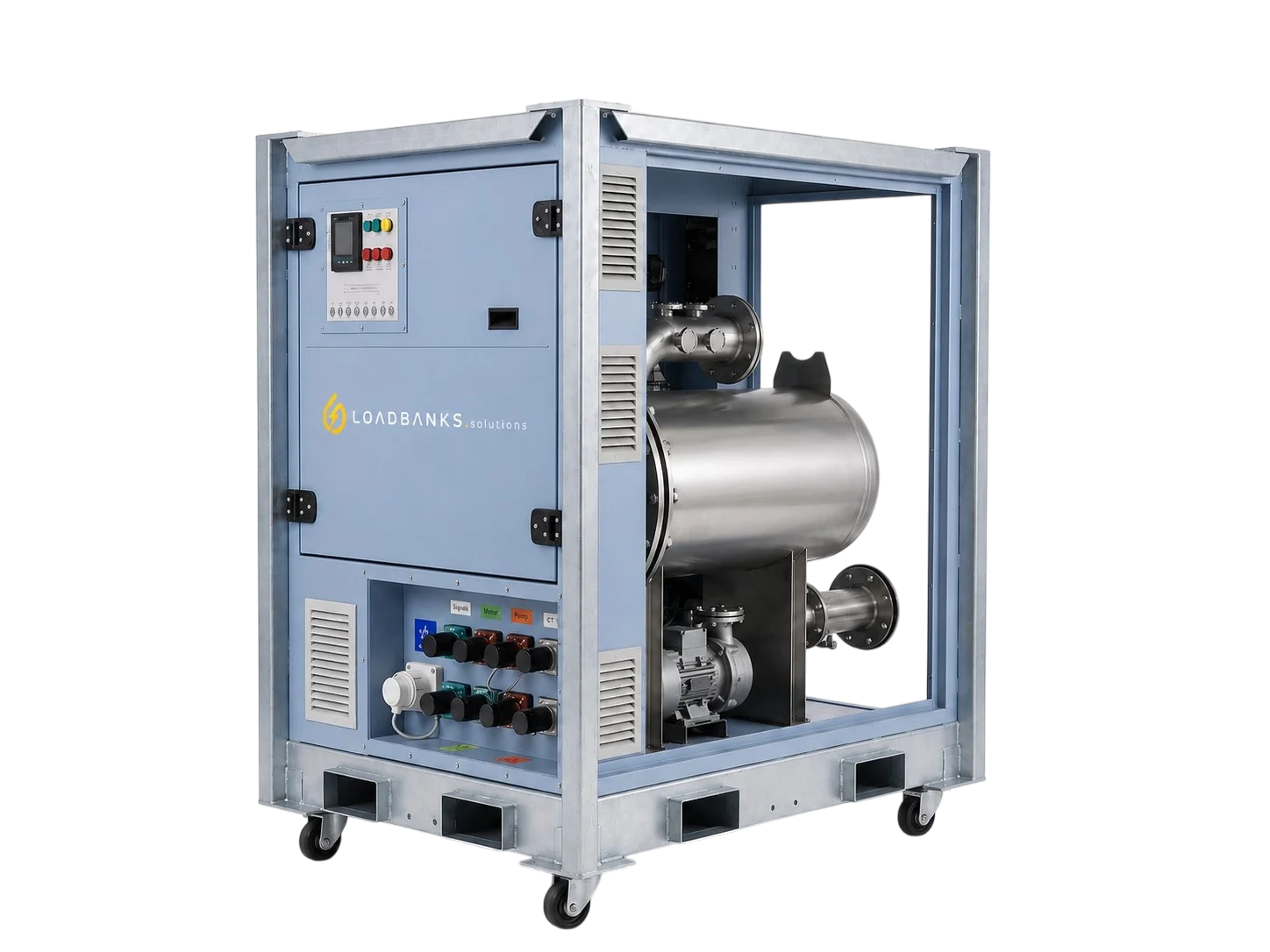
Standard load banks are air-cooled. Resistive elements heat up, fans dissipate the heat into ambient air. If the system under test is also air-cooled — precision air conditioning carrying away room heat — the thermal chain roughly matches. But if the system is liquid-cooled — CDU, distribution manifold, cooling tower — a fan-cooled load bank never enters the liquid circuit. The entire cooling infrastructure sits idle during the full-load test. You validated the electrical system. The cooling system passed only on paper. This is not a question of efficiency. It's the difference between tested and untested.
Key insight: Four dimensions — physical fit, interfaces, protocols, and cooling path — and a mismatch in any one of them makes a standard load bank unfit for purpose. Customization in load banks is not an upgrade. It is the minimum viable product for project-specific testing.
1.5 Two Precision Gaps in Testing
Even when physical fit and interfaces happen to match, standard products carry two structural gaps in testing capability.
Load step resolution. Standard load banks switch in discrete steps — 25kW, 50kW. This design comes from generator testing: no-load → half-load → full-load, confirming the engine doesn't stall or overheat at each stage. Coarse steps are sufficient for that logic.
Real loads are continuous. Three hundred servers ramping from idle to full load draw a smooth power curve, not a staircase. During that ramp, the UPS transient voltage sag depth and recovery time are the two numbers you most need to know. A 50kW step skips over the critical mid-range. The conclusion reads "full-load steady state — normal." The missing answer is: "at 143kW — the most common operating range — efficiency shows a systematic dip."
Coarse steps deliver pass/fail. Fine steps with programmable curves deliver performance characterization and boundary exploration.
The data-to-conclusion gap. A standard unit tells you Phase B voltage was 228.7V in hour three of the test. It does not tell you whether that reading means pass or fail for Tier III certification. It certainly doesn't tell you which page of the report that number belongs on.
Certification bodies, grid operators, and insurers have report format requirements that are highly fragmented — waveform screenshot resolution, timestamp format, the specific clause reference used for the pass/fail threshold — varying by region. Standard products don't perform this translation layer. They assume you write the report yourself. For one or two tests a year, that's manageable. For multiple tests with formal reports each time, it's a recurring drain on engineering hours.
1.6 What the Industry Data Shows
The demand for precision and reliability in critical infrastructure testing is not a subjective opinion. Industry data provides reference points:
- UPS systems are the leading root cause of serious data center outages. Uptime Institute's 2024 Annual Outage Analysis identifies power failure as the primary cause of significant data center downtime, with UPS systems as the number-one source among those failures — despite most facilities having redundant UPS capacity installed.
- The average cost of a single unplanned outage exceeds $1 million (Uptime Institute 2024), and the trend is upward. This includes direct business losses, equipment damage, compliance penalties, and reputational impact.
- The global data center market is growing at approximately 10% annually (CBRE 2023), with projections through 2030. Emerging markets — Middle East, Southeast Asia — are growing faster, amplifying demand for commissioning and acceptance testing on new builds.
- Battery energy storage installations are scaling rapidly. Industry estimates show global annual BESS additions growing from roughly 10GW in 2020 to over 50GW by 2025. Every grid-connected project requires charge/discharge cycle capacity testing.
These numbers point to the same conclusion: demand for load testing is growing. The complexity of what's being tested is growing. But the way testing capability is acquired hasn't evolved at the same pace.
2. Rent-to-Own: Pay as You Use
2.1 The Common Dilemma
A typical project team has a clear need: a fully customized load bank — power rating, cooling method, interfaces, control protocols — all built to project specifications. The problem is equally clear: the equipment will be used only a few times a year. Spending six figures on an asset that sits in storage most of the time doesn't pass the financial review.
Renting standard equipment: low upfront cost. But standard equipment cannot be customized. What you rent is incompatible interfaces, mismatched protocols, and the wrong report format. It's a constraint, not a capability.
2.2 How the Structure Works
Rent-to-own flips the sequence. You don't need to accumulate budget before using the equipment. You use it first, pay monthly. At any point you decide to own it, every payment made up to that point counts as a paid installment toward the purchase price.
Three stages:
Configure
Same as buying. Full customization — power rating, cooling method, interface specifications, control protocols, safety interlocks. All built to project requirements.
Use
Equipment delivered to site. Pay a usage fee on a monthly basis. The equipment runs at your project site. Maintenance, spare parts, and technical support are handled by the manufacturer.
Buy Out
When project demand becomes long-term, or a new build needs the same equipment, you decide. All usage fees paid to date offset the purchase price at 100%. Pay only the difference.
Why 100% offset is viable. The equipment was built to your project's specifications — CDU flange dimensions, rack spacing, control protocol data point tables are all project-specific. If you don't buy it out, this equipment has no second buyer on the open market. The sunk cost of customization stays with the manufacturer. In the contract design, this risk is not on the project side.
Three paths compared:
| Purchase | Pure Rental | Rent-to-Own | |
|---|---|---|---|
| Customization | Yes | No (standard only) | Yes |
| Initial Outlay | Full price | Monthly fee | Monthly fee |
| Ownership | Immediate | Never | After buyout |
| Storage & Maintenance | You | Rental company | Manufacturer |
| Future Purchase | Already owned | Procure separately | Paid rent fully credited |
Example. A project runs 4 test cycles per year, 3–5 days each. Needs a custom liquid-cooled load bank at 500kW.
Purchase: equipment ~€150K one-time, plus ~€8K/year for storage and maintenance. Pure rental: ~€25K per test cycle, ~€100K/year — but you can't rent custom equipment. Rent-to-own: pay a monthly usage fee, ~€100K/year, using a unit built to your project specifications. After two years, decide to buy out — €200K already paid, fully credited. Equipment original price €180K. No additional payment required at buyout.
3. What the Requirement Spec Doesn't Say
"We need a load bank for commissioning testing."
That sentence is not wrong. What's missing isn't parameters — it's the full set of boundary conditions that determine whether the project executes smoothly. The following questions don't come from a survey template. Each one comes from real projects where the answer wasn't confirmed in advance, and the result was on-site rework: re-cabling, re-terminating, re-protocol-mapping — two days lost.
If you're testing a power supply system:
- Is the load bank connecting at the UPS output or the PDU endpoint? At the PDU endpoint, voltage drop across the distribution-to-rack cabling enters your test data — is that intentional, or is it noise?
- How much equipment cannot be taken offline during testing? What's the load isolation plan for A/B dual-path switchover testing — will a sudden load drop affect live IT equipment?
- Is there a 400A+ industrial socket or busway tap-off point on site? If not, the temporary cabling plan and timeline need to be established before the test window opens — not improvised on test day.
If you're testing a battery energy storage system (BESS):
- AC side or DC side? PCS inverter/rectifier performance is verified on the AC side. Battery string consistency is verified on the DC side. The test setup and load equipment are different for each.
- BMS communication — CAN or Modbus? Real-time SOC and cell voltage readings are prerequisites for safety judgment during testing. Without access to this data, deep discharge testing cannot proceed.
- Charge/discharge C-rate? Cutoff criterion by cell voltage or SOC? Different standards mean different test schedules and safety thresholds.
If you have a cooling system to validate:
- Air cooling via precision AC or liquid cooling via CDU? The requirements for the load bank are completely different.
- If liquid-cooled: CDU flange specifications, supply/return design delta-T and flow range, and whether the liquid cooling loop runs independently or in parallel with actual IT cooling load during testing.
These questions cannot be answered by any standard specification sheet. They only surface when someone walks onto the site, opens the distribution cabinet door, and talks face-to-face with the local electrical subcontractor.
4. The Distance Problem
Something that happened in the industry.
A newly built data center was running a full-load generator test. Power readings were normal, voltage normal, frequency normal — all remote instrumentation showed green across the board. The test engineer followed the inspection checklist and went up to the roof to check the exhaust stack. Near the seal between the stack and the waterproofing membrane, there was smoke. Lifting the seal revealed that the support structure around the exhaust duct was made of timber. The exhaust pipe operating temperature exceeded 400°C. The wood was smoldering.
No sensor triggered an alarm. Voltage waveforms and power curves don't report support material properties. This was only discovered because a person physically walked to that location.
Another overseas commissioning project. The main motor wouldn't start. The control system was sending the correct start signal. Digital outputs and relay status showed everything normal. The contactor wasn't pulling in. The engineer traced the cable meter by meter with a multimeter and found it had been mechanically damaged inside the conduit during installation — a physical break. Every signal on the remote interface was green. No fault code anywhere.
Two events. One conclusion. Physical-world problems — incorrectly installed materials, cables damaged during laying, interface defects that only reveal themselves under site conditions — exist entirely outside the field of view of remote monitoring.
In international projects, distance amplifies this. Time zones mean a local-time fault occurs in the middle of the night on the other side of the world. The industrial language spoken on site — not the terminology in standard documents, but the technical jargon a subcontractor uses while looking at the same drawing next to you — gets lost in the translation chain. The commissioning authority's preference for report formatting. The local subcontractor's convention for phase sequence labeling. None of this lives in any standard document. You only learn it after a report gets rejected once.
You don't need to hope someone happens to walk to that position, at that time. Because someone is already there.
5. Conclusion
This guide started from four physical dimensions, two testing precision gaps, and a set of industry data to map the systematic limitations of standard load banks in critical infrastructure testing. This is not a product quality issue. It is a structural mismatch between product design positioning and project operational requirements.
Rent-to-own offers a transaction structure that is neither "buy" nor "rent" — use customized equipment for low-frequency testing, pay as you use, with all prior payments fully credited toward a future buyout. It is not the optimal solution for every scenario. But for projects that need customization yet cannot justify full capital expenditure for low-frequency usage, it fills the gap between the two conventional options the market provides.
On overseas project sites, the impact of physical distance on execution is no less significant than technical parameters. Time zones, language, local regulations, tacit knowledge — these factors determine whether a project completes within its scheduled window or slips by days because of one unanticipated interface detail. The presence of a local engineering team is not a bonus in these areas. It is a requirement.
If you are planning load testing for a new build or expansion project, the framework presented here can serve as a starting point for requirement scoping and solution comparison.
About Us
loadbanks.solutions specializes in load bank R&D and manufacturing, with a production base in Shenzhen, China, and a technical support and customer service office in Weinbach, Germany. We have been designing and building load banks for over ten years, covering air-cooled, liquid-cooled, rack-mount, and mobile product lines, with power ratings from 5kW to 1MW.
Our engineering team is deeply involved across the full chain — from requirement scoping and solution design through equipment manufacturing, on-site commissioning, and test execution. In multiple data center and BESS projects across Europe, the Middle East, and Southeast Asia, our custom load banks and local technical support have delivered quantifiable time and cost savings to project stakeholders.
Contact us: Contact page | info@loadbanks.solutions
Download the full whitepaper
A formatted PDF version is available for offline reading and sharing with your team.
Industry data cited in this whitepaper is drawn from the Uptime Institute Annual Outage Analysis (2024), CBRE Global Data Center Trends Report (2023), and publicly available industry sources. Case study scenarios are based on event descriptions from public industry records. Specific locations and parties have been anonymized.